28/01/2013

Pauline Boudry and Renate Lorenz : Toxic Play in Two Acts

Curated by Electra, which is 'a London based contemporary art organisation which curates, commissions and produces projects by artists working across sound, moving image, performance and the visual arts' probably best known for producing Her Noise Archive and Documentary, and bringing Her Noise to Tate Modern in 2012.

Here is an excerpt of heir statement on the show Toxic Play In Tow Acts, which I strongly recommend:
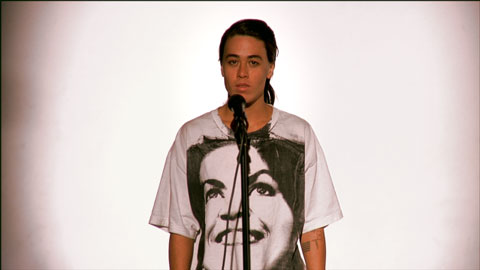
'Toxic, 2012, is a new work drawing on the artists' ongoing interest in the Theatre of the Ridiculous - performances by Jack Smith, with scripts and films by Ronald Tavel, in the late 1960s in New York - which formulated a mocking and outrageous queer critique of capitalism and the normalisation of bodies. The installation presents performances by Ginger Brooks Takahashi and Werner Hirsch, which explore ideas of both the toxic, and of toxicity - substances and people that threaten and destabilise conventional notions of purity and stability. Ultimately turning the lens on itself, Toxic interrogates the filmic apparatus as a medium of toxic substances and effects. The film installation is accompanied by local archival research from Paris and London that charts moments of representational ambiguity in the early history of police photography.'

Salomania, 2009

There will be a screening on the 1 February at Tate Tanks, art of another Electra's production: Charming for the Revolution: A Congress for Gender Talents and Wildness
and on the 20 February at the South London Gallery: Reflections Without Sun

in the meantime check out Pauline and Renate's website.

Sanja Ivekovic: Unkown Heroine

I have visited Ivekovic's exhibition at the South London Gallery (part of the Unknown Heroine exhibition between this venue and Calvert 22) with Karen, little Nancy and little Matilde. Here are some notes.
I've known Ivekovic's work through a catalog offered to me by a friend a couple of years ago, so I was quite excited to see it for the first time. The 1970s video work is what I found most interesting, specially 'Instructions nº1' from 1976, where the artist draws little arrows on her face, similar to those a plastic surgeon would make, and then massages them out blurring the ink onto her face. More striking perhaps because the artist is very young in this video and one could even state, quite beautiful. Nonetheless society's construction of beauty sets such standards that even a perfectly wealthy young woman would find something in need of correction.

Many of Ivekovic's works in this gallery confront images taken from the media and the artist's own image, or images of other young women, this strategy is applied in more recent works as well, where for example fashion images are confronted with the very same imagery that produced them, such as 'Figure and Ground' 2005/6


or in works where fashion images of women wearing sun glasses is brought together with short stories of domestic violence in order to produce a sleek catalog. I did wonder about the repetition of the 1970s strategies nowadays, their effectiveness, or if they become yet another shinny object of desire. Perhaps if I had encountered this mock-magazine on other circumstances, such as waiting for a dentist appointment,  I would find them effective, but maybe is only my own artistic wishful thinking - for it would be a strategy I would also use.

Going specifically to see Ivekovic's work I was more fascinated by another exhibition, 'Toxic Play in Two Acts' (my notes here) by Pauline Boudry and Renate Lorenz, which I strongly recommend.

The exhibition is on until the 24 February 2013.
South London Gallery
65-67 Peckham Road
London SE5 8UH
and
Calvert 22
22 CALVERT AVENUE
LONDON, E2 7JP

Hopefully I will manage to see the other part before it finishes.

24/01/2013

Ana Velez e Inês Norton

Na galeria Bloco103
[Rua Rodrigo da Fonseca, 103B - Lisboa]
inauguração 5.ª feira, dia 31 de Janeiro, às 19h30.

Ana Velez
Inês Norton

Charming for the Revolution: A Congress for Gender Talents and Wildness

1–2 February 2013
The Tanks at Tate Modern
Bankside, London
SE1 9TG
www.tate.org.uk


A collaboration between Tate Modern and Electra

Charming for the Revolution is an experimental congress of artists, activists and thinkers who seek to unpick underpinning, pressing questions of contemporary sexual and gender politics; exploring strategies that divert and destabilise normative gender and its representations. The series of events gathers several major international figures who explore radical expressions of sexuality and gender. Their work invokes what Kathy Acker called the ‘languages of wonder, not of judgment’ to imagine new paths to liberation and social justice. This constellation of events at Tate Modern will highlight a range of positions, representations and manifestos to assess and debate an exciting, emerging field of shifting identities, active communities and political dreams.
The series features films, performance and a major international symposium and brings together the UK premiere of Wu Tsang‘s award-winning film Wildness alongside a new performance by Kelela, Ashland Mines, and Wu Tsang; a symposium convened by Carlos Motta with Xabier Arakistain, Giuseppe Campuzano, J. Jack Halberstam, Esben Esther Pirelli Benestad, Beatriz Preciado, Dean Spade, Terre Thaemlitz, Wu Tsang, Del LaGrace Volcano and Campbell X; a new performance by Carlos Motta and Matthias Sperling; and a screening of works by Pauline Boudry/Renate Lorenz.
Pauline Boudry/Renate Lorenz Friday 1 February, 19h
The work of Berlin-based artist duo Pauline Boudry/Renate Lorenz reflects on the interplay of sexuality, sexual perversions and representation, continuously returning to unrepresented or illegible moments in history. This screening and artists’ conversation brings together three recent works by Boudry/Lorenz: a staging of punk archives from a period between 1970 and 2031 in No Future/No Past; a radical reimagining of the housewife set in Berlin Zoo in Charming for the Revolution; and a layering of labour, class, desire and drag in Normal Work. Here a host of characters are portrayed, living—indeed thriving—in defiance of convention, law and economy.
Gender Talents: A Special AddressSaturday 2 February, 10.30–16.30h
Gender Talents: A Special Address, convened and moderated by artist Carlos Motta, presents an international group of thinkers, activists and artists in a symposium that uses the manifesto as a structure. These ‘special addresses’ will explore models and strategies that transform the ways in which society perversely defines and regulates bodies. The event asks what is at stake when collapsing, inverting or abandoning the gender binary.
Participants: Xabier Arakistain, Giuseppe Campuzano, J. Jack Halberstam, Carlos Motta, Esben Esther Pirelli Benestad, Beatriz Preciado, Dean Spade, Terre Thaemlitz, Wu Tsang, Del LaGrace Volcano, and Campbell X.
Carlos Motta and Matthias Sperling: The Movers  Saturday 2 February, 16.30h
Free
The Movers is a performance conceived in collaboration between Carlos Motta and choreographer Matthias Sperling. The work attends to movement as a means of exploring the connections between collective politics and a sense of the individual. Based on a choreographic score of performative tasks that engage thirteen performers in individual decision-making processes, The Movers abstractly asks how self-determination is both a deeply personal project and continuously negotiated in relation to others.
Performers: Ingo Andersson – Wotever World, Jason Barker, Dan Daw, Simon Foxall, Fred Gehrig, Nia Hughes, Jamila Johnson Small, Helka Kaski, Huai-Chih Liang, Vicky Malin, Malinda Mukuma, Carlos Maria Romero, and Mickel Smithen & Ebony Rose Dark.
The Movers is part of Gender Talents, a Creative Capital Project.
Wu Tsang: WildnessSaturday 2 February, 20h
Wildness is a portrait of the Silver Platter, a historic bar on the eastside of Los Angeles that has catered to the Latin immigrant and queer community since 1963. With a touch of magical realism, the bar itself becomes a character in the film. Voiced by a transgender actress from Guatemala, it whispers the histories of the LGBT community for whom it has provided sanctuary and a ‘safe space’ for generations.
The film captures the creativity and conflict that ensue when a group of young, queer artists of colour (Wu Tsang, DJs NGUZUNGUZU and Total Freedom) organise a weekly performance party, also called Wildness, at the bar. This emergent underground interfaces with the immigrant transwomen who have long populated the venue and the Silver Platter becomes a charged forum for forging coalitions and exploring class, community and activism.
Kelela, Ashland Mines, and Wu Tsang: Breakdown Saturday 2 February, 21.30h
Free
Breakdown is a performance conceived for the Tanks by Kelela, Ashland Mines, and Wu Tsang. Part grand illusion and part humble direct action, this stage show is meant to explore the idea of honesty. Honesty not in the sense of being morally upright, but in the sense of being true to desires or needs. The artists use basic elements of voice, sound, and light to create continuity (storytelling) through a series of constructions/breakdowns, in which the song is simultaneously the derivative and the original. Breakdown is part of an ongoing series of parties/sound/experiences that began in Los Angeles.
A combined ticket for all events is available.
Tate Film is supported by Maja Hoffmann / LUMA Foundation.
Electra is supported by Arts Council England.
Realised with the kind support of Creative Capital, IFA The Institut für Auslandsbeziehungen and the Norwegian Embassy.
30/11/2012

MaComère - Contemporary Women Artists, Fall 2013


CFP: MaComère - Contemporary Women Artists, Fall 2013

Deadline: Dec 30, 2012
CALL FOR PAPERS MACOMÈRE
THE JOURNAL OF THE ASSOCIATION OF CARIBBEAN WOMEN WRITERS & SCHOLARS
SPECIAL ISSUE: FALL 2013
CONTEMPORARY WOMEN ARTISTS
Given the multilingual and shifting locations of Caribbean women artists, this special issue of MaComère focuses on the work of women whose artistic practices engage with the multiple meanings of the Caribbean and its diaspora. Through diverse written and visual contributions, this special issue seeks to begin a conversation about the ways in which Caribbean women artists, who define themselves as such, engage with and challenge the very notion of the “Caribbean” and introduce nuanced and intertextual concepts in relation to contemporary art practice(s). We invite contributions that contextualize the artwork historically and culturally, while offering close readings of the work by extensively engaging its formal and aesthetic qualities. For our purposes, discussion of Caribbean women's artistic practice will encompass all language areas in the region and its diaspora and is intended to be as inclusive as possible.
We invite submissions in the following areas:
1. Artist Essays. Self-reflective essays written by artists in which they explore their visual arts practice (2,000 - 2,500 words).
2. Visual Art Projects. Projects created by individual artists or in collaboration unique to the MaComère issue (4 pages ie. 2 pages back and front).
3. Critical Essays (no more than 5,000 words): a. Essays making links between the work of one or more Contemporary Women Artists whose visual practices encompass work in any of the following areas: Painting, Drawing, Sculpture, Printmaking, Installation, New Media, Performance, Photography, Land Art, Interventions/Public Art, and Sound Art. b. Essays that explore the frameworks, which provide the contexts for seeing and understanding the work being produced by contemporary female artists. These framing devices might include academic journals and conferences, published texts, periodicals, curated exhibitions, formal and informal networks, national, regional and international exhibitions, biennials and prizes.
4. Reviews of Books (1,500-2,000 words) in which the work of Contemporary Women Artists are featured.
5. Reviews of current and recent exhibitions (1,500-2,000 words) which might include but are not limited to exhibitions such as Infinite Island: Contemporary Caribbean Art (USA); Disillusions: Gendered Visions of the Caribbean and its Diasporas (USA); Caribbean: Crossroads of the World (USA); Wrestling with the Image: Caribbean Interventions (USA); Who More Sci-Fi Than Us? (The Netherlands); Contemporary Jamaican Art, circa 1962 / circa 2012 (Canada), with a focus upon the role / visibility of women in these exhibitions.
Submission process:
Please send a 300-word abstract and a two-page CV to the Guest Editors to the following address:
macomereartissue1@gmail.com Documents should be emailed with a subject line reading “MaComère Special Issue” referencing the submission area in the tagline i.e. Artist Essay, Critical Essay, Book Review, etc. by December 30th, 2012.
Following the review of the abstracts, selected potential contributors will be notified by January 30th and asked to submit their full paper for the peer review process by May 30th 2013. This Special Issue will appear in Fall 2013.
Inquiries can be directed to the Guest Editors:
Annalee Davis (annalee@annaleedavis.com)
Joscelyn Gardner (jg@joscelyngardner.com)
Erica James, Yale University (erica.james@yale.edu)
Jerry Philogene, Dickinson College (philogej@dickinson.edu)
MaComère is a refereed journal that is devoted to scholarly studies and creative works by and about Caribbean Women in the Americas, Europe, and the Caribbean Diaspora. It is the journal of the Association of Caribbean Women Writers and Scholars, an organization founded in 1995 (www.macomerejournal.com).

27/11/2012

chris krauss conference, call for papers

The Critical Writing in Art & Design programme at the Royal College of Art is pleased to announce the first conference on the work of the American writer Chris Kraus, to take place in London on 13-14 March 2013. Alongside presentations of new interpretations of Kraus’s work, the conference will include a reading by the author of some of her writings, an on-stage interview and screening of her films.

We are interested in receiving proposals for both academic and non-academic papers on any aspect of Chris Kraus’s work, or the themes with which it engages, as well as performative/multimedia responses to her work. We are particularly interested in the following areas:

• Kraus as novelist: Papers that specifically address aspects of Kraus’s novels I Love Dick, Aliens & Anorexia, Torpor, and Summer of Hate.

• Kraus as intellectual historian: Kraus’s writing blurs traditional delineations of “fiction” and “nonfiction,” eliciting portraits of such seminal figures as Sylvere Lotringer, Félix Guattari, Simone Weil, Nan Goldin, and William Bronk, to name but a few. Alternately, one might suggest that Kraus uses her work to validate gossip as a serious artistic practice, aligning her endeavor with that of a number of queer and feminist practitioners such as Vaginal Davis, Wayne Koestenbaum, and Dodie Bellamy.

• Kraus as post-feminist philosopher: As Eileen Myles wrote about I Love Dick, "Chris's ultimate achievement is philosophical. She's turned female abjection inside out and aimed it at a man. As if her decades of experience were both a painting and a weapon. As if she, a hag, a kike, a poet, a failed filmmaker, a former go-go dancer—an intellectual, a wife, as if she had the right to go right up to the end of the book and live having felt all that. I Love Dick boldly suggests that Chris Kraus's unswervingly attempted and felt female life is a total work and it didn't kill her."

• Kraus as critic: Papers that explore Kraus’s engagement with the contemporary art world, including the art-critical aspects embedded in her fiction. We are also interested in papers that contextualize Kraus as one of the chief proponents of the emerging field of critico-fiction (alongside such figures as Lynne Tillman, Brian Dillon, Maria Fusco, Tom McCarthy, and Eileen Myles.)

• Kraus as editrix: While Semiotext(e) is widely acknowledged for having introduced “French theory” into American academia in the 1980s, Kraus’s “Native Agents” series, which proposed a parallel trajectory of radical fiction writing, has seldom been considered. We are interested in critical and historical accounts of Semiotext(e) that focus on Kraus’s ongoing contribution to the project.

• Kraus as filmmaker: In Aliens & Anorexia, Kraus presents a somewhat brutal self-assessment of her previous career as a failed filmmaker. If anything, her early film work failed to find a major audience. In recent years, however, as a result of her success as a writer, a revival of interest in her films has been spawned, with major screenings in New York and Los Angeles. Now is the time for a critical reckoning of Kraus’s films, which can potentially be posited within the dialectics of failure.

Please submit a 300 word proposal and short biographical statement to cwad@network.rca.ac.uk. If you plan to present your work in a performative / multimedia format, please indicate the nature of any equipment required. The deadline for proposals is 15 January. Invitations to participate will be made at the end of January. The organizers of this symposium are not able to support the travel or accommodation costs of participation.

21/11/2012

FAZENDO GENERO 10

The International Seminar Fazendo Gênero 10 - Desafios Atuais dos Feminismo (Doing Gender 10 - Current Challenges of Feminisms) will be held in Florianopolis, Santa Catarina, from September 16 to 20, 2013. The event is organized by the Centro de Filosofia e Ciências Humanas and the Centro de Comunicação e Expressão, and supported by other schools of the Federal University of Santa Catarina (UFSC), in partnership with the Centro de Ciências Humanas e Educação of the State University of Santa Catarina (UDESC).
Fazendo Gênero 10 (Doing Gender 10) seeks to: favor the articulation of gender studies with approaches involving other categories of analysis such as class, race, ethnicity, and generations; create spaces for dialogue and exchange of experiences among researchers, teachers and people involved in social movements; encourage the participation of undergraduate and postgraduate students in the field of feminist studies and gender, providing a more qualified training in the area; and produce knowledge that could result in articles to be published in books and periodicals about the theme.
The general conception of the event arises from the consideration that, despite the many advances made by the numerous struggles waged by women, many obstacles still remain, some  reconfigured, others recently emerging, thus requiring a debate on the Current Challenges of Feminisms. Such challenges include, among others, the little participation of women in positions of political power; gender inequalities in the work environment and income distribution; the difficulties faced in the struggle for abortion rights; domestic and institutional gender violence; the critical situation of women, especially the low-income ones, in post-colonial and trans-modern contexts; health inequities; the backlash in the struggle for LGBT rights and in the effects of the intersections of gender, class, generation and race / ethnicity; gender imbalance in the production of scientific knowledge; the significant inclusion of women in contemporary mobility, and many others.
DEADLINES
November 20, 2012 - Announcement of accepted proposals for Thematic Symposia (TS)
November 25, 2012 - Starting date for submission of papers for the Thematic Symposia (TS) and for the submission of Poster proposals
November 25, 2012 - Starting date for submission of proposals for the Photography Exhibit and for the Audiovisual Exhibit.

PT
O Seminário Internacional Fazendo Gênero 10 - Desafios Atuais dos Feminismos se realizará em Florianópolis, Santa Catarina,  entre 16 a 20 de setembro de 2013 e será promovido pelo Centro de Filosofia e Ciências Humanas, pelo Centro de Comunicação e Expressão, bem como por outros Centros da UFSC, em parceria com o Centro de Ciências Humanas e da Educação da UDESC.
O Fazendo Gênero 10 visa favorecer a articulação dos estudos de gênero com abordagens que envolvem outras categorias de análise como classe, raça, etnia, e gerações; criar espaços de troca de experiências e diálogo entre investigadoras/es acadêmicas/os e aquelas/es ligadas/os a outras entidades e aos movimentos sociais; incentivar a participação de estudantes de graduação e de pós-graduação nas discussões travadas no campo dos estudos feministas e de gênero, possibilitando uma formação mais qualificada na área, e produzir conhecimentos que possam resultar em material bibliográfico a ser publicado em livros e periódicos sobre o tema.
A concepção geral do evento considera que, apesar  dos avanços obtidos por meio das inúmeras lutas travadas pelas mulheres, muitos obstáculos persistem, alguns se re-configuraram, outros emergiram,  exigindo por isso mesmo o debate em torno dos Desafios Atuais dos Feminismos, os quais incluem, entre outros, a baixa participação das mulheres nas instâncias de poder político; as desigualdades de gênero no âmbito do trabalho e da distribuição de renda; as dificuldades enfrentadas no âmbito das lutas  pelo direito ao aborto; as violências domésticas e institucionais de gênero; a grave situação das mulheres, principalmente de baixa renda, nos contextos pós-coloniais e transmodernos;  as iniquidades em saúde; as contramarchas nas lutas pelos direitos LGBT e contra os efeitos de subordinação das interseções de gênero, classe, gerações, raça/etnia e deficiência; as assimetrias de gênero no âmbito da participação das mulheres na produção do conhecimento científico; a inserção significativa das mulheres nas mobilidades contemporâneas, etc.

ARTE e GÊNERO
Coordinators: ANA GABRIELA MACEDO (PhD (completed) - Universidade do Minho), SIMONE PEREIRA SCHMIDT (Postdoctoral (completed) - Universidade Federal de Santa Catarina)
Abstract: O objectivo deste painel temático é a apresentação e o diálogo entre comunicações que visem a temática do gênero e da Identidade como um dos desafios mais aliciantes e mais promissores do Feminismo contemporâneo. Pretende-se analisar e discutir "estudos de caso" focando a articulação entre questões de identidade e a problematização do sujeto através da representação visual do corpo e dos espaços que este habita, a casa, a cidade, etc. Pretende-se concretamente que nos estudos de casos apresentados haja um ênfoque em temas como : a política da localização; a cidadania; a problematização da identidade feminina e a construção da subjectividade, entre outros. O diálogo cultural e geracional são igualmente um ênfoque prioritário num painel que pretende situar este debate no cerne de questões actuais da História e da crítica de arte contemporâneas e no diálogo com outros discursos teóricos, estéticos e críticos, tais como a literatura e as interartes.